
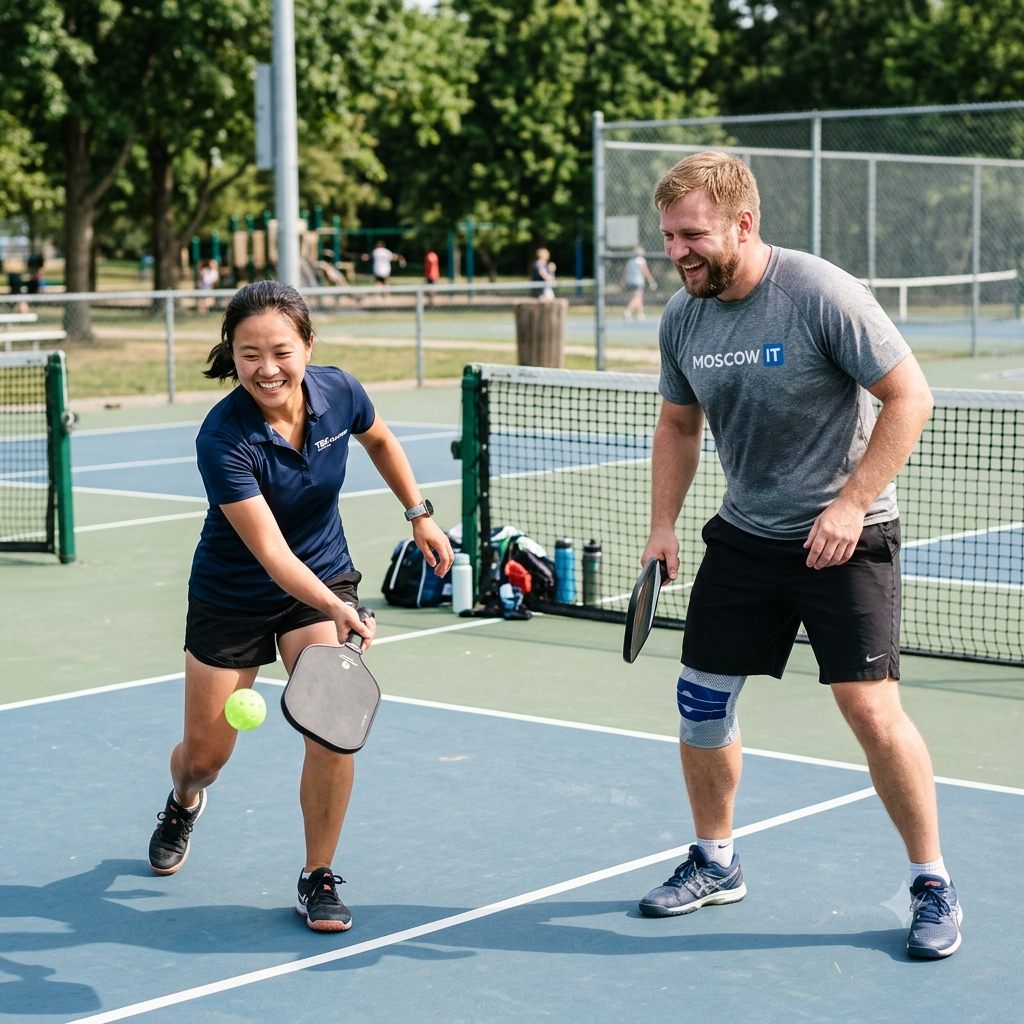
In tech, casual conversation—often called small talk or watercooler banter—frequently happens in the first two minutes of a Zoom call, on Slack/Teams channels, or right after a daily standup.
When talking about hobbies like snowboarding, rock climbing, or pickleball, native speakers rely on specific speech patterns to keep the tone light and informal.
Key Vocabulary & Expressions
- Snowboarding: hit the slopes, powder day, carving, mountain run, shredding
- Rock Climbing: bouldering, climbing gym, belaying, sending a route, top-roping
- Pickleball: dinking, paddle, serving, doubles match, court time
5 Grammar Rules for Casual English
1. Conversational Ellipsis (Dropping Subjects & Auxiliaries)
In relaxed speech, native speakers often drop the subject pronoun (I, you) or auxiliary verbs (are, do, have) at the start of a sentence when the context is obvious.
- Formal: “Are you going to the gym after work today?”
- Casual: “Heading to the gym after work?”
- Formal: “I have never tried pickleball before.”
- Casual: “Never tried pickleball before, but looks fun.”
2. Reduced Forms & Connected Speech
Auxiliary verbs combine with main verbs in fast, casual speech. While written formally in emails, these reductions are standard in spoken English.
- Gonna (going to): “I’m gonna hit the climbing gym around 6.”
- Wanna (want to): “Do you wanna grab a paddle and play a quick match?”
- Tryna (trying to): “I’m tryna get better at snowboarding this winter.”
3. Present Continuous for Fixed Future Plans
Instead of using “will” for future plans, native speakers almost always use the Present Continuous (be + verb-ing) for planned evening or weekend activities.
- Stilted/Formal: “I will play pickleball tomorrow night.”
- Natural/Casual: “I’m playing pickleball tomorrow night with some friends.”
- Natural/Casual: “We’re heading up to the mountains this Friday to snowboard.”
4. Softeners & Hedges (Kinda, Pretty, Bit of)
To avoid sounding overly intense or direct, casual speech uses hedging words to soften statements or describe difficulty level.
- Direct: “Rock climbing is difficult.”
- Casual: “Bouldering is pretty tough, but it’s a great workout after sitting all day.”
- Casual: “I’m kinda sore from playing pickleball yesterday.”
5. Idiomatic Phrasal Verbs for Activities
Casual English favors phrasal verbs over precise formal verbs when starting, continuing, or finishing hobbies.
| Formal Verb | Casual Phrasal Verb | Casual Example |
| Start / Begin | Get into | “I recently got into indoor bouldering.” |
| Go to / Visit | Head over to / Hit | “Let’s hit the pickleball courts after work.” |
| Participate in | Take up / Join in | “A few devs on my team took up snowboarding last season.” |
| Relax / Unwind | Decompress / Blow off steam | “Climbing is how I blow off steam after a heavy sprint.” |
10 Speaking Practice Questions
Use these questions to practice speaking aloud. Focus on using contractions, softeners, and natural phrasal verbs!
- “How do you usually like to unwind or blow off steam after a long sprint or launch week?”
- “Have you ever tried snowboarding, or are you more of a warm-weather person?”
- “If a teammate invited you to go rock climbing after work, would you give it a shot or pass?”
- “Pickleball has been blowing up lately—have you played yet, or are there courts near your office?”
- “What’s your go-to activity when you’ve been sitting in front of code or monitors all day?”
- “Do you prefer solo activities to decompress, or group sports where you can catch up with colleagues?”
- “What’s the most adventurous sport or outdoor hobby you’ve ever tried?”
- “How do you usually answer when someone asks, ‘Got any fun plans for the weekend?’“
- “Would you rather try indoor bouldering (climbing without ropes) or head out for a mountain hike after work?”
- “If our team organized an after-work social sports event, which activity would you vote for and why?”
* Enjoy more English training. Refer a friend and get two free classes this summer, one for you and one for your friend. Help your friend start advanced English training with a consultation. *


Leave a Reply